
All praise is due to Allah Subhanahu wa Ta’ala, who guides hearts toward His Book and allows communities to flourish through sincere efforts dedicated to His pleasure. In an era defined by rapid change, constant digital noise, and shifting moral standards, institutions grounded in Qur’anic education play a role that is both timeless and urgently contemporary.
They are not simply places of instruction; they are foundations for identity, discipline, and spiritual clarity.
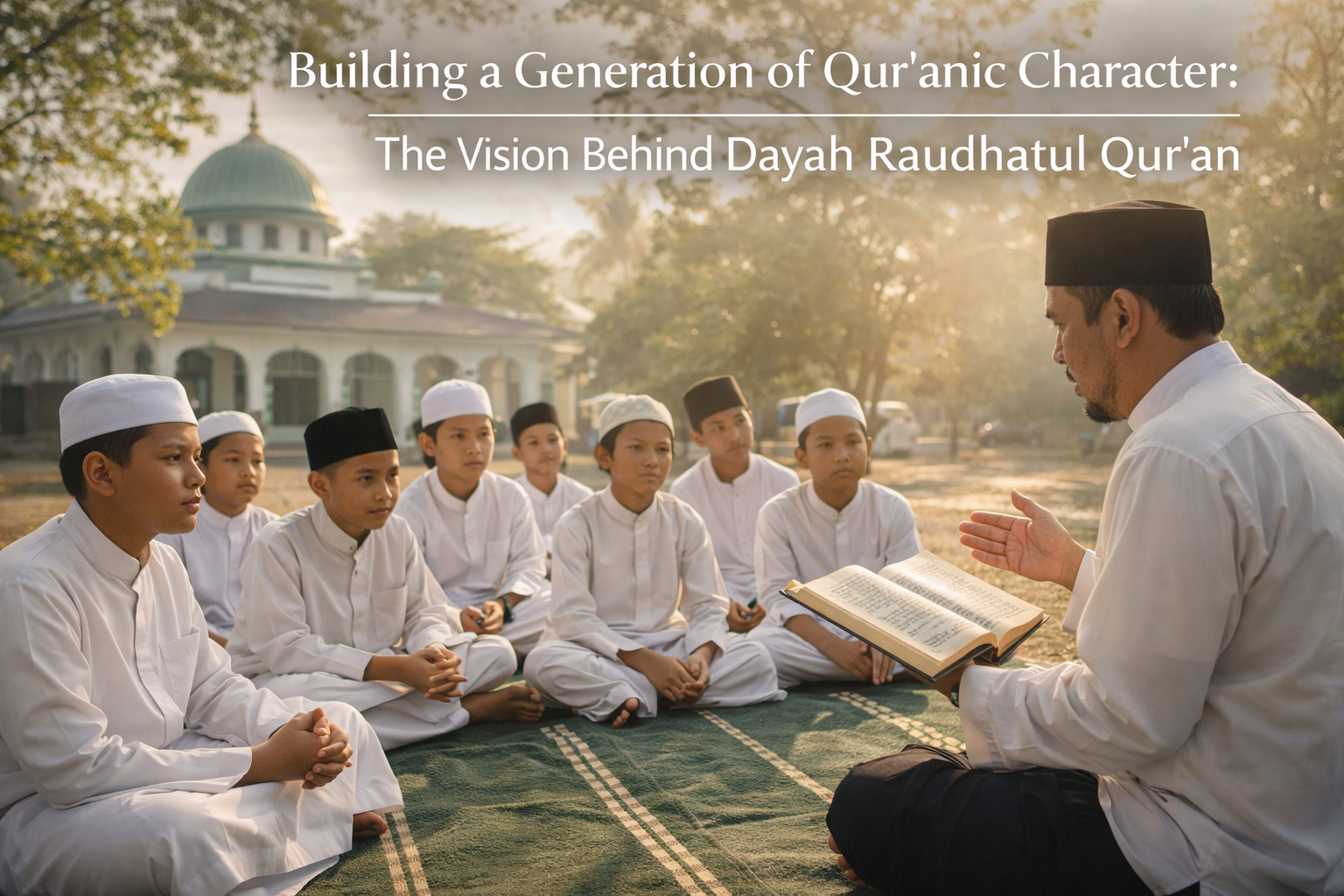
Dayah Raudhatul Qur’an stands as an example of how meaningful Islamic education often begins quietly. What started as a small home-based pengajian has grown into a structured learning environment focused on nurturing love for the Qur’an and strengthening the character of the Muslim community.
The story of such growth is not merely about expansion. It is about consistency, sincerity, and commitment to preserving values in a world that frequently challenges them.
The Power of Humble Beginnings in Islamic Education
Many respected Islamic institutions did not begin with formal campuses or elaborate planning structures. They began with gatherings in living rooms, on prayer mats, and in circles formed by neighbors seeking knowledge. The early phase of Dayah Raudhatul Qur’an reflects this tradition. A small group came together to recite the Qur’an, to correct tajwid, and to instill moral awareness in children who needed guidance beyond what conventional schooling could offer.
From these modest beginnings emerged something deeper than a program. A culture began to form. Parents observed a change in their children. Children became more attentive in prayer. Families developed routines around recitation and reflection. Word spread naturally, not through marketing campaigns but through lived transformation.
As attendance increased, structure became necessary. Schedules were organized, curricula refined, and responsibilities clarified. The informal gathering evolved into a dayah without losing the warmth and intimacy of its origins. That balance between structure and sincerity is what gives institutions like Dayah Raudhatul Qur’an their enduring strength.
Why Qur’anic Education Must Go Beyond Memorization
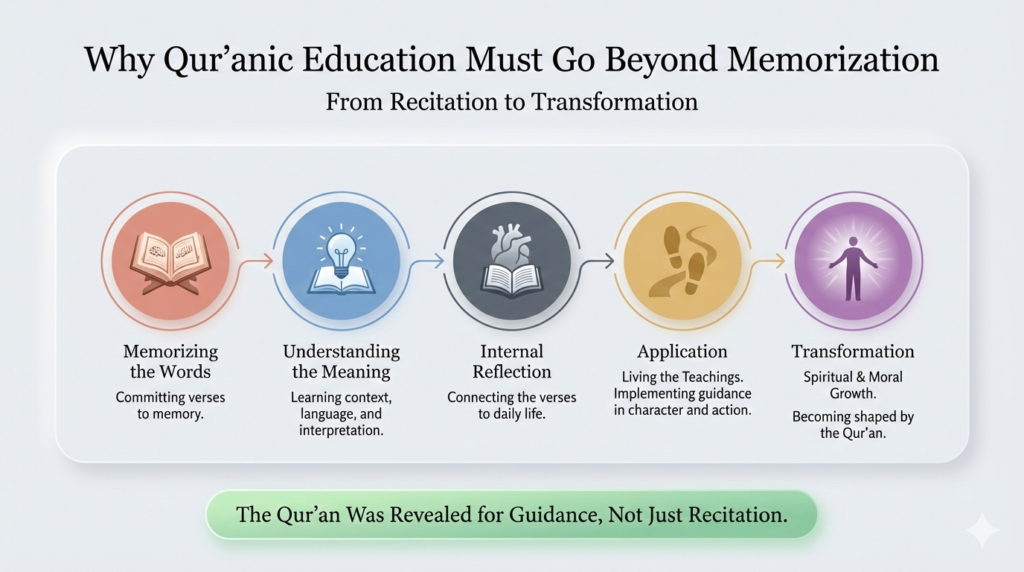
In many Muslim communities, Qur’anic education is commonly equated with memorization. Parents proudly speak of how many juz their children have completed, and institutions often measure progress by how quickly students advance through the text. There is no doubt that memorizing the Qur’an is an honorable and deeply rewarding act. The preservation of the Qur’an through memorization is one of the greatest blessings granted to this ummah. However, reducing Qur’anic education to memorization alone risks overlooking the broader and more transformative purpose of revelation.
The Qur’an was not revealed merely to be recited beautifully or stored in memory. It was revealed as guidance for life. Allah describes the Qur’an as a source of direction, mercy, healing, and light. Its verses address belief, character, justice, family life, community responsibility, and personal accountability. When students memorize without understanding, they may carry the words but miss the weight of their meaning. True Qur’anic education must therefore move beyond repetition and cultivate comprehension, reflection, and lived practice.
Understanding does not necessarily mean mastering advanced tafsir at a young age. Rather, it means connecting verses to everyday behavior. When children learn about honesty in the Qur’an, they should see how that honesty applies to their speech at home and school. When they recite verses about patience, they should be encouraged to practice patience in their interactions with siblings and classmates. In this way, memorization becomes a foundation for character, not an isolated achievement.
Authentic Qur’anic education also builds discipline. The process of regular recitation, revision, and correction teaches consistency and focus. Students learn that progress requires effort and that mastery requires repetition. This discipline extends beyond the classroom. A child who learns to maintain daily revision habits often develops stronger time management skills and a deeper sense of responsibility in other areas of life.
Humility is another essential outcome. The more one engages with the Qur’an, the more one recognizes the depth of divine wisdom and the limits of human understanding. A student who is taught to approach the Qur’an with reverence learns that knowledge is a trust, not a tool for superiority. Education that emphasizes humility protects against arrogance and nurtures gratitude.
Patience, too, becomes a natural byproduct. Memorization can be challenging. Correcting pronunciation, refining tajwid, and revising long passages require perseverance. When guided properly, students learn that growth often comes slowly and that consistency matters more than speed.
Finally, Qur’anic education shapes ethical awareness. The Qur’an continuously calls believers toward justice, compassion, and accountability. When students are encouraged to reflect on these themes, they begin to internalize a moral compass rooted in revelation rather than in shifting cultural trends.
In essence, memorization is the doorway, not the destination. The ultimate goal of Qur’anic education is transformation — the shaping of hearts, minds, and behavior in alignment with divine guidance. When institutions commit to this holistic vision, they do more than produce memorizers; they nurture individuals whose lives reflect the very message they recite.
Navigating Islamic Education in the Modern World
Contemporary challenges demand thoughtful responses from Islamic institutions. Children today are exposed to influences that previous generations did not encounter.
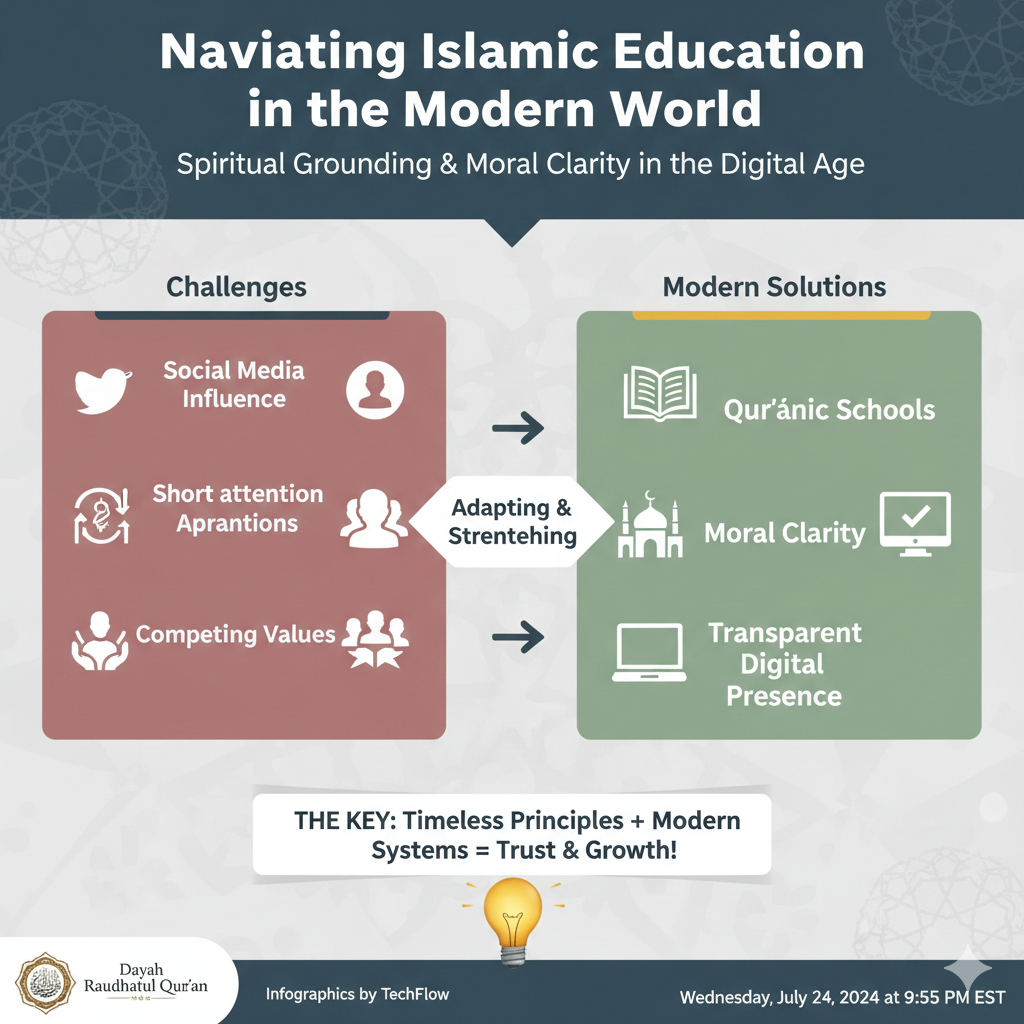
Social media platforms shape identity, short-form content shortens attention spans, and global narratives compete with traditional values. Parents increasingly search for reliable Qur’anic schools and dayah programs that provide both spiritual grounding and moral clarity.
For institutions like Dayah Raudhatul Qur’an, adapting to these realities does not mean compromising principles. It means strengthening them while embracing responsible systems that support sustainable growth. Clear communication, organized scheduling, and professional administration are no longer optional features; they are essential components of maintaining trust within the community.
When families seek information about Qur’anic education programs, they look for transparency. They want to understand the mission, teaching philosophy, and learning environment before entrusting their children to an institution.
A well-structured online presence helps communicate these values effectively. The website of Dayah Raudhatul Qur’an serves as an accessible platform where parents can learn about the institution’s origins, educational goals, and commitment to character development.
The Importance of Digital Organization for Islamic Institutions
Even institutions rooted in traditional scholarship must navigate modern communication systems. Registration inquiries, program announcements, and community updates are increasingly managed through digital channels. Without proper organization, administrative tasks can overwhelm educators and distract from the core mission of teaching.
Managing communication effectively requires thoughtful systems. When testing new registration tools or evaluating different communication platforms, administrators often benefit from using throw-away email services during setup phases to avoid overloading official accounts.
Digital efficiency ultimately protects the most valuable resource within any Islamic institution: the time and focus of its teachers. The more streamlined the administrative structure, the more energy educators can devote to meaningful instruction.
Building Trust Through Consistency and Transparency
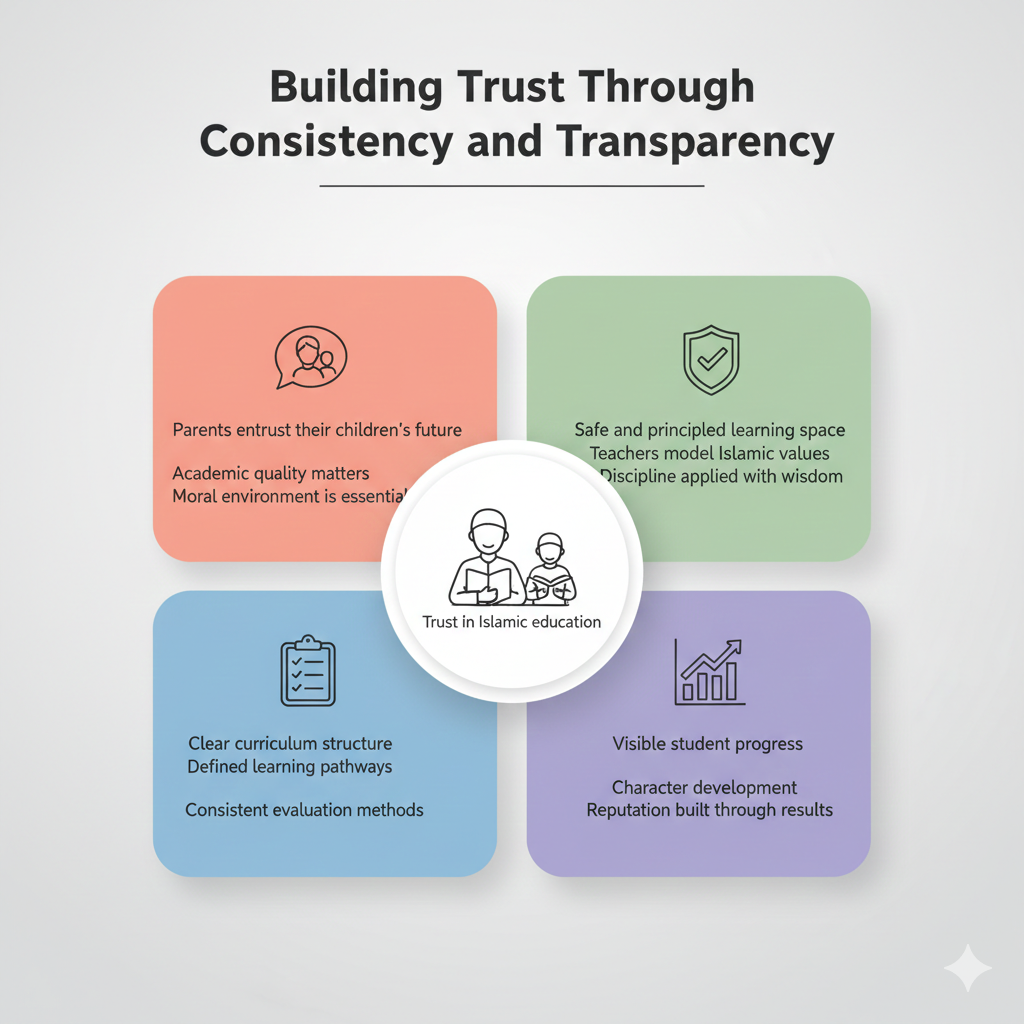
Trust is the cornerstone of any enduring Qur’anic institution. When parents entrust their children to a dayah or Islamic learning center, they are not simply enrolling them in classes. They are placing their hopes, values, and spiritual aspirations in the hands of educators.
This responsibility extends beyond teaching correct recitation or memorization techniques. It includes nurturing a safe, principled environment where children are guided with care, integrity, and wisdom.
For families, confidence in an institution rests on two pillars: consistency and transparency. Consistency assures parents that standards will not fluctuate from one classroom to another or from one term to the next. When lessons follow a structured curriculum and expectations remain clear, students benefit from stability.
They understand what is required of them, and parents can track their progress with clarity. This structured approach prevents education from becoming improvised or reactive.
Transparency strengthens this stability. Clearly communicated goals, teaching methods, and evaluation systems allow families to see how learning is organized. When institutions outline how tajwid is assessed, how memorization is reviewed, and how character development is reinforced, parents feel included in the process. They are not left guessing how progress is measured. Instead, they witness growth step by step.
Equally important is the visible character of teachers. Parents observe not only what educators teach but also how they behave. When instructors model patience, humility, and fairness, they embody the very values they seek to instill.
Discipline applied with balance and compassion reinforces trust rather than undermines it. Children thrive in environments where authority is exercised with wisdom rather than harshness.
The growth of Dayah Raudhatul Qur’an illustrates how trust develops organically. As families observed steady improvement in their children’s recitation, manners, and spiritual awareness, confidence deepened.
Enrollment increased not because of aggressive promotion, but because of authentic results. In the field of Islamic education, reputation is built gradually through lived experience. When institutions remain transparent, structured, and consistent, trust becomes their most powerful foundation.
Akhlak as the Core of Sustainable Impact
Perhaps the most significant measure of success for any Qur’anic dayah is the character of its graduates. Academic achievement may earn recognition, but moral integrity earns respect. A student who internalizes Qur’anic values becomes a source of benefit long after formal lessons conclude.
Institutions that prioritize akhlak alongside scholarship create ripple effects across generations. A child who learns patience in the classroom carries that patience into family life. A teenager who develops discipline through structured Qur’an study applies that discipline in professional pursuits later in life. Over time, communities shaped by such individuals exhibit stronger cohesion and ethical awareness.
The emphasis on moral refinement distinguishes enduring Islamic institutions from temporary programs. Dayah Raudhatul Qur’an’s commitment to nurturing both knowledge and character ensures that its impact extends beyond memorization milestones.
Preserving Sincerity Amid Growth
Growth presents opportunities but also responsibilities. As an institution expands, it must guard against losing the sincerity that defined its beginnings. Administrative sophistication should never replace spiritual intention. Expansion should serve the mission rather than overshadow it.
Sustainability in Islamic education depends on balancing vision with humility. While buildings may grow larger and enrollment may increase, the heart of the dayah must remain anchored in its original purpose: cultivating love for the Qur’an and strengthening the moral fabric of the ummah.
Dayah Raudhatul Qur’an’s journey from a home-based gathering to a structured institution illustrates how growth can occur without compromising authenticity. Its continued development depends on preserving that balance.
Looking Toward the Future of Qur’anic Education
The future of Qur’anic education will demand a careful balance between preservation and progress. Islamic institutions must remain firmly rooted in traditional scholarship while thoughtfully engaging with the realities of a rapidly changing world. The foundations of learning — qualified teachers, sound methodology, and authentic transmission — cannot be compromised. At the same time, the tools and environments through which students learn are evolving, and institutions must be prepared to adapt responsibly.
Technology will continue to shape how education is delivered and managed. Digital platforms can support revision, facilitate communication with parents, and expand access to qualified teachers beyond geographic boundaries. Online learning environments, structured digital resources, and organized administrative systems can enhance efficiency without diminishing spiritual depth. When used wisely, technology becomes a support system rather than a distraction.
Despite these developments, the essential needs of students will remain unchanged. Young learners still require mentorship, personal attention, and moral guidance. They need structure that cultivates discipline and environments that encourage reflection. Most importantly, they need a meaningful connection to the Qur’an that goes beyond academic achievement.
The future of Qur’anic education lies not in choosing between tradition and innovation, but in integrating them thoughtfully. Institutions that maintain scholarly integrity while embracing responsible adaptation will be best positioned to guide the next generation — nurturing hearts that remain anchored in revelation regardless of how the world around them transforms.

